
Generation and Application of Ultra-Fine, Long-Term Stable Nanobubble Water: An Evaluation of Inclusion Effects on Aromatic Components and Antimicrobial Activity
Nov. 19, 2026
Shimizu S, Tanaka M, Tominaga N, et al. Generation and Application of Ultra-Fine, Long-Term Stable Nanobubble Water: An Evaluation of Inclusion Effects on Aromatic Components and Antimicrobial Activity. International Journal of Molecular Sciences. 2026;27(15):6909.
https://doi.org/10.3390/ijms27156909
Research Overview
Ultrafine bubble (nanobubble) water containing gases such as hydrogen and ozone is being considered for applications in various fields. In this study, we evaluated the aroma compound retention capacity and antibacterial activity of long-term stable nanobubble water, designated as “NanoGAS water (NGW).” Various NGW formulations containing air, hydrogen, or ozone were tested by quantifying the retention of citral—a representative volatile aroma compound—and assessing their inhibitory effects on bacterial colony formation. Furthermore, the effects of combining NGW with antibacterial and antiviral compounds were also examined.
1. Preparation and Long-Term Stability of NGW
NGW was prepared by combining a gas-liquid mixed fluid rotary mixer and a shear filter. In the particle count measurements, samples from 1 week and 10 years after production were compared, and particles were detected even in the sample that had elapsed for a long period.
2. Retention Effect of the Aroma Component Citral
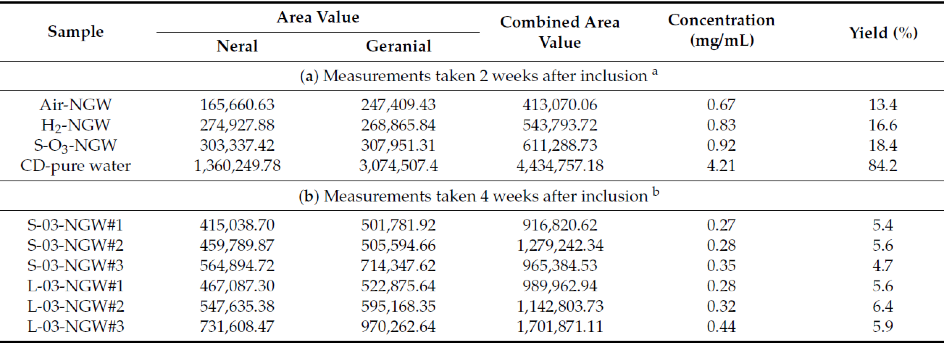
To evaluate the retention effect of the aroma component, citral was mixed into NGW and measured by gas chromatography-mass spectrometry (GC/MS). Cyclodextrin, which has the property of encapsulating aroma components, was used as a comparative control.
The yields of citral measured two weeks after mixing were 13.4% for air-containing NGW, 16.6% for hydrogen-containing NGW, and 18.4% for ozone-containing NGW containing small bubbles. In contrast, the yield for the cyclodextrin solution was 84.2%.
Additionally, when the ozone-containing NGW was measured four weeks after mixing, the citral yield was 4.7% to 6.4%.
These results demonstrate that citral was detected in the NGW samples, and that the retained amount varies depending on the sample type and measurement timing.
(Citral concentration in the sample: sum of neral and geranial values)
3. Antibacterial Activity of NGW
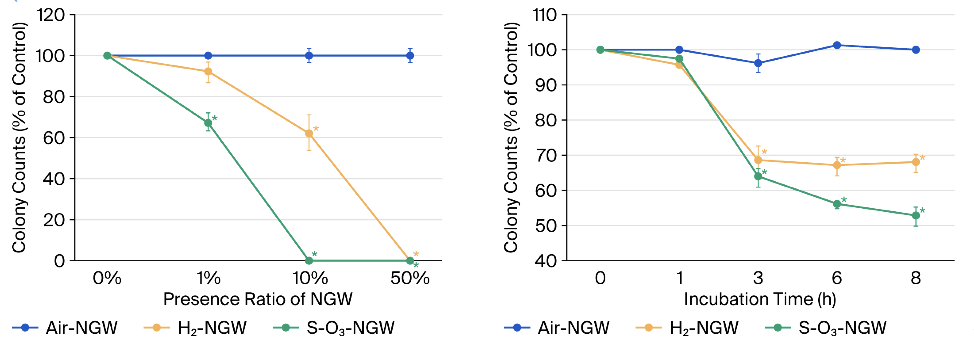
Regarding the antibacterial activity of NGW, bacterial suspensions were treated with various types of NGW, and the number of colonies formed after incubation was measured.
While the air-containing NGW showed almost no antibacterial activity, the hydrogen-containing NGW reduced the number of colonies by approximately 40% at a 10% concentration, and completely inhibited colony formation at a 50% concentration.
With the ozone-containing NGW, an effect was observed even at lower concentrations, with complete inhibition of colony formation at a 10% concentration.
Furthermore, in an experiment examining changes over treatment time using a 1% dilution of NGW, both the hydrogen-containing and ozone-containing NGW significantly inhibited colony formation three hours after the start of treatment. The ozone-containing NGW showed an inhibition effect of approximately 50% after eight hours.
4. Combined Effects with Antibacterial Compounds
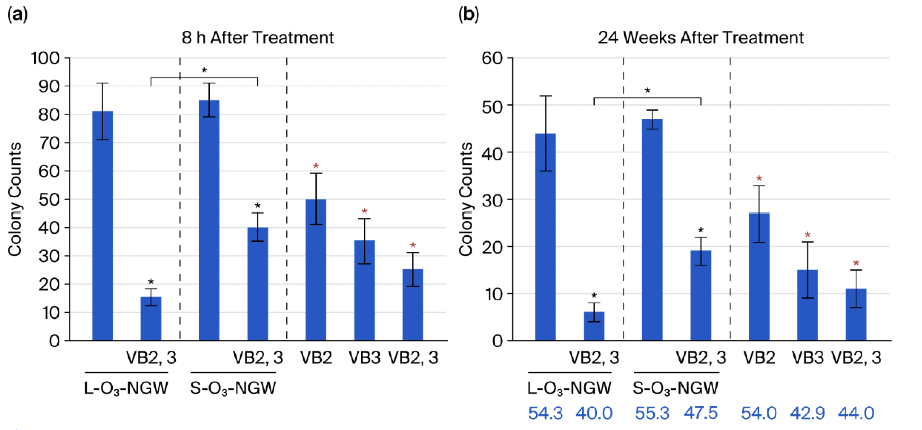
In an experiment combining ozone-containing NGW and the polyoxometalate-based compound VirusBlock (VB), the suppressive effect on bacterial colony formation by the combination was examined.
Although treatment with ozone-containing NGW alone reduced the colony count, the combination with VB2 and VB3 further reduced the number of colonies.
In addition, antibacterial activity was evaluated for samples stored for 24 weeks, and antibacterial effects were confirmed in samples combining NGW and VB.
Conclusion
In this study, the retention effect of the aroma component citral and the effect on bacterial colony formation were investigated for NanoGAS water.
As a result, citral was detected in the NGW samples, and the suppression of bacterial colony formation was observed in hydrogen-containing NGW and ozone-containing NGW. Particularly for ozone-containing NGW, antibacterial activity was confirmed even under diluted conditions, and suppressive effects through combination with VirusBlock were also observed.
This study presents laboratory evaluation results regarding the aroma component retention and antibacterial activity of nanobubble water, providing foundational knowledge for future applications.
Patient website

Website for Healthcare Professionals


